
You’re stuck, but not because you can’t move forward. Deep down, you may not want to. Your self-awareness has plateaued. Flatlined, even. You may be caught a fixed identity. Growth isn’t possible inside the comfort zone. It’s time to become your own alchemist. That means identifying the archetypes that shape your personality so you can choose them, challenge them, and evolve beyond them.
Each archetype contains a unique set of skills, knowledge, experience and therefore wisdom, that you can tap into for insights into yourself and others.

Photo by Ron Lach on Pexels.com
You have 12 personal archetypes in total.
Now, before we go any further, I need to tell you two things. First, you can do this exercise on your own, but it also works well as a pair and share exercise. That way, you can use each other as a sounding board and get feedback at the same time.
The second thing I want to mention is that, according to Caroline Myss, author of Sacred Contracts: Awakening Your Divine Potential, there are 4 archetypes we all share. They are the Child, Victim, Prostitute and Saboteur. You can read more about them here. Now, I’m not asking you to subscribe to the idea of 4 shared archetypes, but you will get a more well rounded picture of your personality if you do. But don’t take my word for it. Test it for yourself.
You will be combining these 4 plus your choice of 8 to make 12 archetypes in the next steps.
1. You can identify your archetypes by referring to the list below and then selecting 8 that you can say you’ve always been. For example, I can say that I’ve always been a mother. How? I mothered my siblings during my early years, nurtured my friends, inspired life-long learning in my students, and single-parented my own children. Maybe you’ve always been an advocate. You’ve always stood up for those unable to stand up for themselves. Or maybe you’ve always been an artist. You’ve been drawing and painting ever since you can remember. You get the idea.
You have 4 primary archetypes we all share, so now, go ahead and choose your 8 secondary archetypes from the list below.
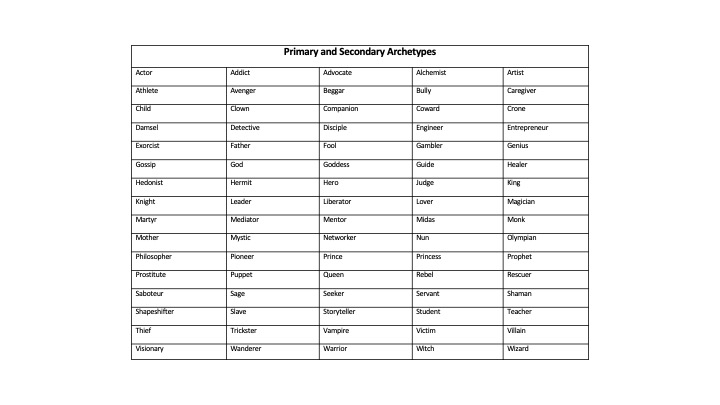
2. Next, deconstruct all 12 archetypes. You might prefer to work with one archetype a day. Brainstorm the archetype’s negative and positive elements in equal proportions. List 10 of each. Don’t overthink this part. You’re brainstorming it so nothing you list is silly or wrong.
Here’s an example of the Lover Archetype, deconstructed by a client I’ll call Lisa:
| Negative Lover | Positive Lover |
| lost touch with passion | touch the passion |
| disconnected | connect |
| flitting around | settle |
| not committed | commit |
| careless | care |
| avoidance | face it |
| afraid to care | enjoy caring |
| betrayed | loyal and true |
| disappointed | better expectations |
| wrung out | clean start |
| no passion | ignites passion |
| no interest | interest |
3. You’re going to Self-author all 12 archetypes. Again, you might like to work with one archetype at a time. Refer to the negative and positive lists for each archetype. From your lists Self-author the archetype by using your associations as prompts to describe and explain the archetype’s Desire, Goal, Fear, Trap, Gift, and Strategy. Desire – the wish or best-case scenario; Goal – the aim, outcome or purpose; Trap – the biggest obstacle; Fear – the greatest weakness or worst-case scenario; Gift – the greatest strength or talent; Strategy – outlines a plan of action.
Here’s an example of the Lover Archetype, self-authored by Lisa during one of our coaching sessions.
| Desire | To connect deeply and passionately, to feel alive through love, care, and meaningful emotional bonds. |
| Goal | To care and commit – express love through commitment, presence, and genuine care; to live with heart and passion fully engaged. |
| Fear | Betrayal, disappointment, feeling wrung out for loving too deeply. |
| Trap | Avoiding love and flitting around to numb passion, to protect against pain, detaching, or withholding care to stay “safe.” |
| Gift | To awaken and ignite passion, to bring warmth, loyalty, and wholehearted devotion wherever love flows. |
| Strategy | Face what I fear with love. Care even when it feels risky. Commit to connection, stay loyal to what stirs my heart, so passion can renew itself through presence. |
4. Now you need to let your hard work mull. This is the hands-off point of the process. Seriously. You’re going to allow the magic to take place. It’s time to be your own witness. Then…
Watch what happens.
The magic will arrive in the form of an ah-ha moment or an epiphany. An epiphany will invigorate your energy. It will shift your mindset. It will inspire you. It will deliver a new insight or idea. It will signpost your way forward.
But. This type of magic usually takes time. That’s why you need to let it mull.
Waiting for an epiphany is not something you want to do because waiting adds dead weight to the process. Weighting slows, and can even block, the flow of your epiphany.
Then again, a reaction might be instant. For Lisa, she began to realise it was a lack of willingness to commit to being passionate that was blocking her passion and inspiration. She recognised that her fear of being wrung out was the reason why she was unwilling. Lisa had to identify ways to reach her goal so that she could enjoy caring again. Then, after reading about the four primary archetypes, notably the Victim Archetype, Lisa also realised she needed to monitor her personal boundaries to avoid slipping into doing too much for others.
Epiphanies tend to quicken when you experiment on a regular basis. You’ll have more epiphanies, more often, meaning they will arrive in less time.
So don’t wait. Be patient. Busy yourself by doing something else. Archetypes run on their own time. And, if you find that the archetype you’ve analysed is not accurate, then choose another to analyse. You can’t get this wrong. Remember, you’re conducting an experiment.
You can expand your self-awareness when you trigger your own epiphany. Make your own magic. Simply choose an archetype, deconstruct it, self-author it, let it mull and watch what happens.
Discover more from Gail Goodwin
Subscribe to get the latest posts sent to your email.
 Gail Goodwin
6 thoughts on “The Magic of Archetypes”
Comments are closed.