
Your personal archetypes are a gateway to transformation. They teach you to perceive life from a symbolic perspective. They provide you with a lens through which you can view both the known and hidden aspects of your personality. By recognising these patterns, you gain objectivity over situations that might otherwise be all consuming. It’s a skill I call Archetypal Intelligence.
Your thoughts, behaviours, and experiences tend to form universal patterns rather than isolated incidents. Instead of seeing life events as random, you begin to recognise them as symbolic expressions of deeper themes.
Your personal archetypes give you a symbolic framework for understanding the meaning of your life. They reveal both the seen and unseen dimensions of your personality. By recognising their patterns, we gain the clarity to navigate challenges without being consumed by them: it’s a skill I call Archetypal Intelligence.
Gail Goodwin 2025
Let me use the Saboteur Archetype as an example of how it can function as a gateway to transformation. When you view self-sabotage through this lens, it becomes clear that poor decisions aren’t simply mistakes. They’re manifestations of an internal struggle between the desire for growth, a fear of not learning, and a therefore a fear of change.
The Saboteur is often the voice of negative self-talk. If you’re constantly telling yourself, “I’m not good enough,” you’re not only doubting yourself; your Saboteur is expressing a fear of failure, rejection, or fear of appearing stupid, and therefore embarrassed, humiliated or ashamed. But the moment you Self-author this archetype, which is where you shape its role rather than being shaped by it, you will uncover its purpose and true potential.

Recognising these fears as expressions of the Saboteur archetype grants you with enough distance to transform them, to relieve them of their outdated assistance, to develop or mature them. You begin to see that the Saboteur is not your enemy but an assistant, albeit a clumsy one in its current form, trying to protect you from perceived risks. Consciously reframing your thoughts by Self-authoring this archetype, means you can make braver choices and even turn the Saboteur into an ally for growth.
Symbolic perspective is tool, not a home. This perspective is a visitor’s pass, not a permanent residence.
Gail Goodwin 2025
Viewing life symbolically allows us to rise above difficult circumstances by providing a bird’s-eye perspective. But let’s be clear. This is a visitor’s pass, not a permanent residence.
Symbolic perception is not an excuse to blame our archetypes for our problems. Yes, your archetypes will act out, demanding attention so you can nurture them, and learn from them, but your true, Sacred Self is the part of you, the real you, that’s pure and undamaged. Once you enter the energy of your Sacred Self, from there you can function objectively but also with compassion. When you enter the energy of your Sacred Self, you enter a state of balance.
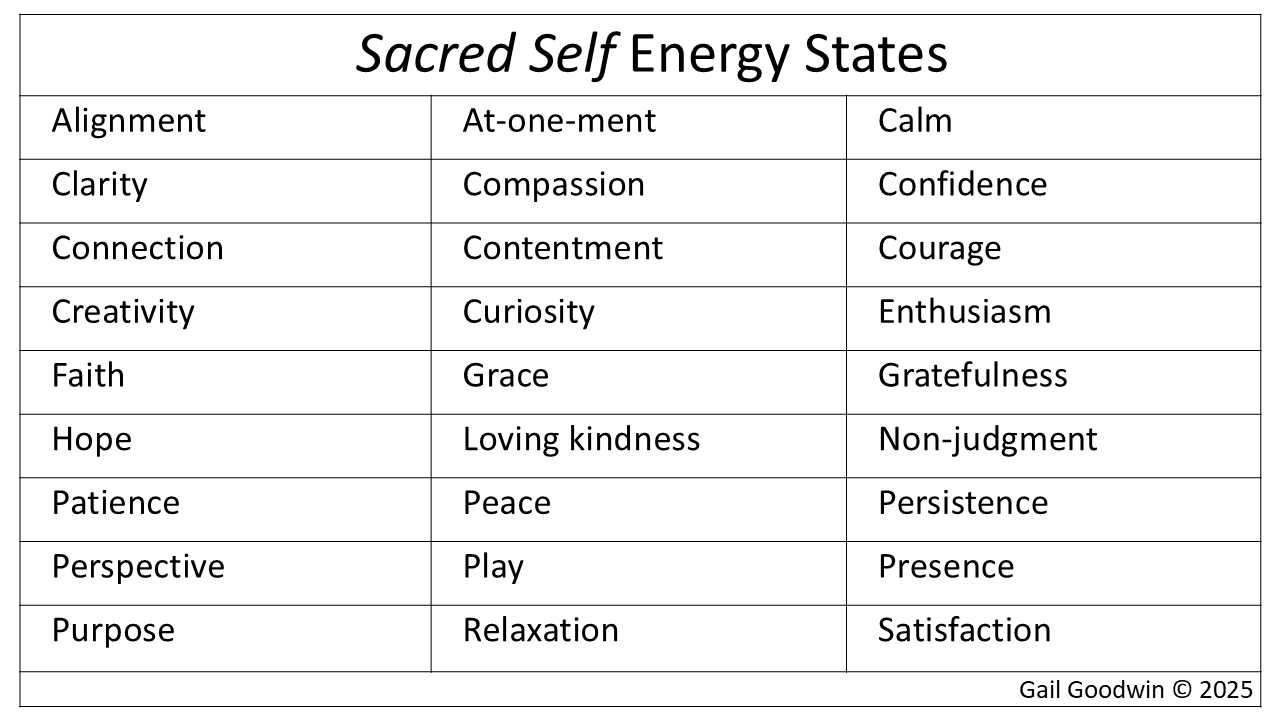
Too much objectivity detaches your mind and body from your emotions. It reduces empathy, withholds compassion, and blocks authentic connection. It can lead to suppressed feelings, unchecked stress, and misunderstandings in relationships, where others feel unheard, minimised, or invalidated. Moreover, excessive detachment stifles creative thinking, intuitive insights, and emotional intelligence, all of which are essential for problem-solving, decision-making, and personal growth.
Self-authoring your archetypes is an assured path to learning and growth
Gail Goodwin 2025
When you use archetypes as symbolic representations and expressions rather than enemies, you gain the power to transform them into divine attendant spirits: guides rather than adversaries. When you self-author an archetype, you reframe your thoughts so you can make more empowered decisions. You begin to recognise that it’s not you. Not the real, authentic, Sacred Self you. It’s your archetypes, flawed, but instructive, and finally grabbing your attention.
When you appreciate your faults, they lose their power over you. Acknowledging and accepting your imperfections with kindness, honesty, and compassion neutralises the shame or fear tied to them. Instead of suppressing or battling flawed archetypes, recognising, allowing, consulting, and nurturing them creates a safe space where they can express their concerns without controlling your life.
Developing your Archetypal Intelligence is about bringing your personal archetypes into the light of awareness so you can release their grip on your false identities. Loving your flaws gets easier once you accept that the real you is found in the energy of your Sacred Self. You’re creating the freedom to learn and grow without self-judgement.
 Gail Goodwin
You must be logged in to post a comment.