
You need to make a life changing decision but you don’t know where to start. You’re over making hasty, ill conceived decisions. They’ve caused too many regrets. The consequences of rash decisions have taken too much time and energy to either come to terms with or undo. You’re tired of learning the hard way.
When you’re faced with making a potentially life changing decision then you need to make it a conscious one. Quitting your job, starting a new job, retiring or coming out of retirement, leaving a relationship, committing to a new relationship, starting or selling a business, moving house, moving interstate or overseas, buying a house have a huge impact on the course of your life and those that are important to you. Making ill-conceived decisions can affect your destiny in ways that you later regret.
Yes, you can follow your bliss but make sure you do it mindfully. When you think through a decision first, you put yourself in a better position to maintain your personal agency during the process. Sleeping on it for at least a few days can do the same for you.
Sure, you can overthink a decision. You dwell on it for too long. Then complain that you’re confused or overwhelmed. Part of the problem here could be that you have too many options available for handling the decision making process.

Photo by Craig Adderley on Pexels.com
You can generate a live volcano by ignoring it or hoping the problem evaporates. Deep down you know it won’t.
Too much thinking or not enough thinking won’t deliver what you want quietly or without a struggle.
A classic way to make a decision is to think it through by generating a list of pros and cons. But this listing will be different. You’re going to consult an archetype.
To assist you to make your decision you’re going to:
- Write down the problem
- Choose an archetype
- Deconstruct it
- Self-author it (yes, I’ve borrowed the term from Jordan B Peterson)
- Let it mull
- Watch what happens
Here are the details:
Write down the problem by formulating it as an open-ended question.
Choose an archetype that represents your situation. Here’s the list:
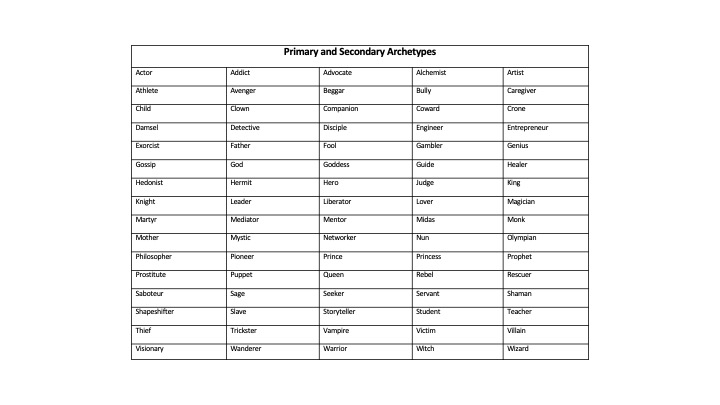
Deconstruct the archetype by brainstorming a list of 6 negative associations and 6 positive associations. You can list more associations, but if you do, make sure that both lists have the same number of items.
Self Author the archetype. Refer to both lists to identify your goal, strategy, talent, strength, weakness and your fear about your situation.
Let it mull. In other words don’t wait for answers or for something to happen. You’ve done your part.
Watch what happens. Be conscious of letting the process take care of itself. The insight or idea will arrive when it’s ready to make itself known to you.
Here’s an example:
I’ll call the client Sophie. Sophie needed to make a decision about how to proceed with a project at work. After a discussion to clarify the real problem, Sophie formulated the following question:
How can I improve my leadership skills?
Sophie chose the Peacemaker archetype to represent the situation. Then she deconstructed it like this:
| Peacemaker Archetype – Negative | Peacemaker Archetype – Positive |
| Rattled | Calm |
| Confused | Clearheaded |
| Goes on the attack | Works collaboratively |
| Creates conflict | Generates creativity |
| Puts people offside | Brings people together |
| Creates enemies | Creates camaraderie |
The takeaways for Sophie? By self-authoring the Peacemaker archetype – see below – Sophie identified the following so she was clear about what she needed to do next.
- Goal: to create camaraderie.
- Strategy: to work collaboratively.
- Talent: bringing people together.
- Strength: to be clearheaded.
- Weakness: getting rattled.
- Fear: putting people offside.
When it comes to making a well conceived decision, there’s a big difference between writing a simple list of pros and cons, and consulting an archetype.
In the ancient tradition of alchemy, something magical happens when elements in opposition are brought together and unified. Transformation occurs when positive and negative forces coalesce because of a third, catalytic agent. That catalyst is your spirit.
The result? Inspiration, insights and direction forward.
References
Mark M, & Pearson C, 2001, The hero and the outlaw: building extraordinary brands through the power of archetypes.McGraw-Hill, New York.
Myss C, 2001, Sacred Contracts: awakening your divine potential. Random House, New York.
Discover more from Gail Goodwin
Subscribe to get the latest posts sent to your email.
 Gail Goodwin
2 thoughts on “How to Make a Well Conceived Decision”
Comments are closed.